


Internews and the BBC World Service Trust are partners in a DfID funded consortium focusing on improving how aid agencies communicate with disaster affected communities. The emphasis is on the need to deliver information, as aid itself, through the most appropriate channels ...more
Infoasaid
CDAC
infoasaid is a collaborative project of two CDAC (Communicating with Disaster Affected Communities) Network members. The CDAC Network is a cross-sector collaboration between international media organisations, NGOs, the Red Cross movement and UN agencies. Participating organisations are committed to mainstreaming the capacity for beneficiary communications into humanitarian policy and practice. The current Steering Committee consists of: ALNAP; BBCWST; British Red Cross; HAP International; International Media Support (IMS); infoasaid; Internews; Irish Red Cross; Merlin; OCHA; Plan UK; Save the Children; Thomson Reuters Foundation; UNFPA.

Innovation of Technologies in Sports Betting

Experience the future of sports betting - discover the innovative technologies revolutionizing the industry!

Guitar Trends

Are you a music lover with an interest in guitars? Then you've come to the right place!
In this article, we'll explore the latest guitar trends, from sales and usage statistics to industry growth and facts.
We'll also look at legendary guitars, including those owned by Johnny Ramone, Kurt Cobain, Eric Clapton, and Elvis Presley.
So, get ready to learn more about the guitar market and its dynamics!
The Therapeutic Aspect of Playing Guitar

For centuries, music has remained a fundamental component of human culture, functioning as a method of conveying messages, providing amusement, and allowing self-expression. Beyond its capacity for entertainment, music holds a healing potential that can significantly influence our emotional and mental health. Stay Tuned Guitar Blog agrees that among the instruments available for harnessing this therapeutic potential, the guitar stands out as one of the most versatile and easily accessible. Playing the guitar goes beyond mere musical skill; it possesses the capability to mend and bring solace to the spirit.
Sports Entertainment Trends

Are you ready to learn about the latest trends in sports and entertainment?
From industry leaders discussing their views to streaming services and the rise of NFTs, the industry is changing rapidly.
Discover the opportunities for brands, creators, and athletes, along with the social impact of media.
Get ready to explore the ever-evolving world of sports and entertainment!
Mobile technology in emergency response
Assessing the mobile environment: Factors affecting the suitability of SMS and mobile for communicating with disaster-affected communities
To improve communications with disaster affected communities, infoasaid has partnered with Frontline SMS. Frontline SMS is a mobile phone open source solution, created to overcome communication barriers faced by NGO’s. Frontline SMS leverages basic tools — computers and mobile phones — to enable instantaneous two-way communication on a large scale.
In determining whether, and how to use mobile technology, in particular SMS, in emergency response context matters. Factors such as the state of the national mobile market, customs around the use and control of mobile phones, and the current condition of the network are all important considerations. Frontline SMS in collaboration with infoasaid have developed a checklist which seeks to set factors to be aware of in assessing the mobile context. They are not weighted or prioritised, but rather present an overall picture which should inform decision-making.
Frontline SMS Checklist
NEW: Nepal media landscape guide
September 12, 2011
infoasaid publishes Nepal media landscape guide
Nepal is settling down after several years of social upheaval and radical political change.
But it remains one of the poorest countries in Asia, at constant risk of major natural disasters. These range from devastating earthquakes to droughts and floods.
However, Nepal's private media is flourishing in a new era of democracy and press freedom.
More than 300 FM radio stations – most of which are linked by content sharing networks - offer aid agencies new ways of keeping in touch with local communities.
And more than third of all Nepalese own a mobile phone.
Find out how aid agencies can establish effective two-way communication with Nepal’s most isolated and vulnerable communities by consulting infoasaid’s new Nepal Media and Telecoms Landscape Guide.
Click here to read it.
UPDATE- Cote d’Ivoire Media Landscape Guide
August 22, 2011
Cote d’Ivoire Media Landscape Guide updated following end of civil war
Infoasaid has completely revised and updated the Cote d’Ivoire Media and Telecoms Landscape Guide following the overthrow of former President Laurent Gbagbo and the end of the country’s civil war.
The media scene has changed considerably following the accession to power of President Alassane Ouattara in April 2011.
The country, which had been split into separate government and rebel controlled areas for more than eight years, is once more reunited under a single administration.
But the final stages of Cote d’Ivoire’s long-running conflict triggered a new humanitarian emergency. More than half a million Ivorians fled from their homes to escape conflict during the first quarter of this year and most are still afraid to return.
Click here to read the August 2011 revision to infoasaid’s Media and Telecommunications Guide to Cote d’Ivoire. It can help you to reach them.
Combating food insecurity in Northern Kenya
July 29, 2011

Targeted, reliable information can help save lives in crisis-affected communities. As famine is declared in neighbouring Somalia, we’re helping ActionAid to improve vital communication with drought-affected populations in northern Kenya.
Open source mobile solutions such as Frontline SMS and Freedom Fone are enabling two-way communication with vulnerable communities.
- Read more
NEW "Communication is Aid" Animation
July 15, 2011
In any emergency, be it natural disaster or man-made, people's lives are turned upside down. Knowing what's happening, where to go for assistance and who to call for help is crucial to their survival and recovery. The goal of the 'infoasaid' project is to help humanitarian organisations integrate two way communication into their emergency programmes. This in turn will improve the quality and coverage of humanitarian response. The 'Communication is Aid' animation is designed to demonstrate the positive impact of two way communication with crisis affected populations.

Beneficiary Communications in Haiti
July 07, 2011
Infoasaid and CDAC Network would like to invite you to a Brown Bag Lunch Presentation on Monday July 18:
Beneficiary Communication Practices and the Effectiveness of Cholera Communication Campaigns in Haiti
Date: Monday July 18, 13:00-14:30
Venue: Internews office in London
- Read more
Providing Humanitarian Information in Pakistan
The infoasaid research report ‘Providing Humanitarian Information to Flood-Affected People in Pakistan’ provides a snapshot of the effectiveness of humanitarian information efforts in the provinces of Sindh and Punjab in Pakistan three months after the devastating July 2010 floods.
The primary goal of the research that surveyed over 1,000 people from eight flood-affected areas in these provinces in November and December 2010, was to provide real-time information to support rapid and effective humanitarian information efforts.
The report offers an overall picture of ‘oases and deserts’. While certain areas and groups had better access to information, whether by media or direct from organisational and official sources, many other areas and groups had little to no meaningful access at all.
Media and Telecoms Landscape Guides
infoasaid is producing a series of media and telecoms landscape guides to developing countries that are vulnerable to humanitarian crises.
These are designed as a tool to help humanitarian agencies to communicate effectively with crisis-affected communities.
All the countries to be profiled are states where the international community is likely to play a major role in responding to humanitarian crises.
The guides contain practical information about media consumption habits and news and information flows in each country.
Improving communication in South Sudan
March 04, 2011
South Sudan
In a country that lives in the midst of a chronic crisis, engaging busy relief and development workers to consider the information needs of people affected by a possible future emergency can be challenging. This was the task for the team sent to Juba, South Sudan by the infoasaid project in preparation for the referendum and the expected increase of returnees from the North.
Since the end of the civil war in 2005 and the signing of the peace agreement 2.5 million people have returned to Southern Sudan without being fully integrated, putting enormous strain on an already fragile infrastructure. Since the referendum the number of returnees is increasing and there are fears of humanitarian crisis as resources are simply too scarce to meet demand. Should there be a resumption of hostilities, this disaster will be compounded as populations move en masse across the country and the basic infrastructure crumbles.
Radio offers a lifeline to Pakistan as crisis worsens
August 04, 2010
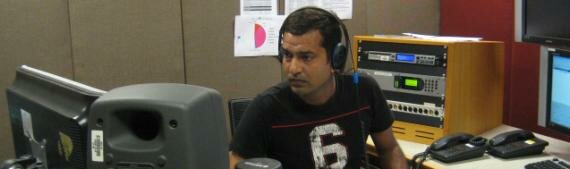 Studio Manager for the Lifeline Bulletins in Islamabad, Pakistan
In response to the devastating floods in northern Pakistan, lifeline radio programmes are to be broadcast in the most severely affected areas through the BBC Urdu service.
With much of the region's transport and communication links destroyed, the programmes will plug a critical gap in delivering information in the immediate aftermath of the disaster using one of the only media channels still available - radio.